The Submission That Terrifies My Coach: A Risk I Take Anyway
When playing it safe means losing, smaller grapplers learn to invert against bigger opponents. Here's why I keep swinging for the choke, even when my neck is the foundation.
There's a particular sound my coach makes when he sees me load up for it. It's not quite a scream, not quite a sigh—somewhere between exasperation and genuine fear. He'll yell something, half-joking, half-lethal, and I usually don't even hear him because I'm already committed. I'm already upside down. I've already put my entire body weight onto my cervical spine, and the only thing left is the result.
The move he's yelling about is the one I've made a habit of doing: inverting against bigger opponents, launching triangles and other submissions from a position where the other person is standing, and I am essentially hanging myself by my own neck to finish a choke.
When I described it to someone recently, I said, "If someone Mike Isertel's size decides they're gonna drop down and forward, they could literally break my neck." They didn't laugh either.
The Match I Thought I Could Win
The conversation that started all of this was about a matchup. I said, out loud, "I think I can win that match." The opponent was bigger than me—significantly bigger. And I meant it. I've faced people that size before. Not casually. Not in a flow roll where we both agreed to play it safe. In real matches. With real stakes. With a referee and a clock and judges who don't care about the orthopedic surgeon I'd need to see afterward.
I've gone the whole way up under my neck in those matches. I've flipped my whole body up to try to shoot triangles. I've launched attacks off the ground while people were standing. And I've done all of that by putting basically all my weight onto my neck.
It's a risk. It's a real risk. My coach understands the technique. He understands the strategy. He also understands that the human spine is not built to receive the full body weight of a grown adult being driven forward by an adult of similar—or greater—size. And he yells at me constantly because of it.
The Mechanics of What I'm Actually Doing
Let me describe what I'm doing, because I want to be honest about what I'm asking my body to absorb.
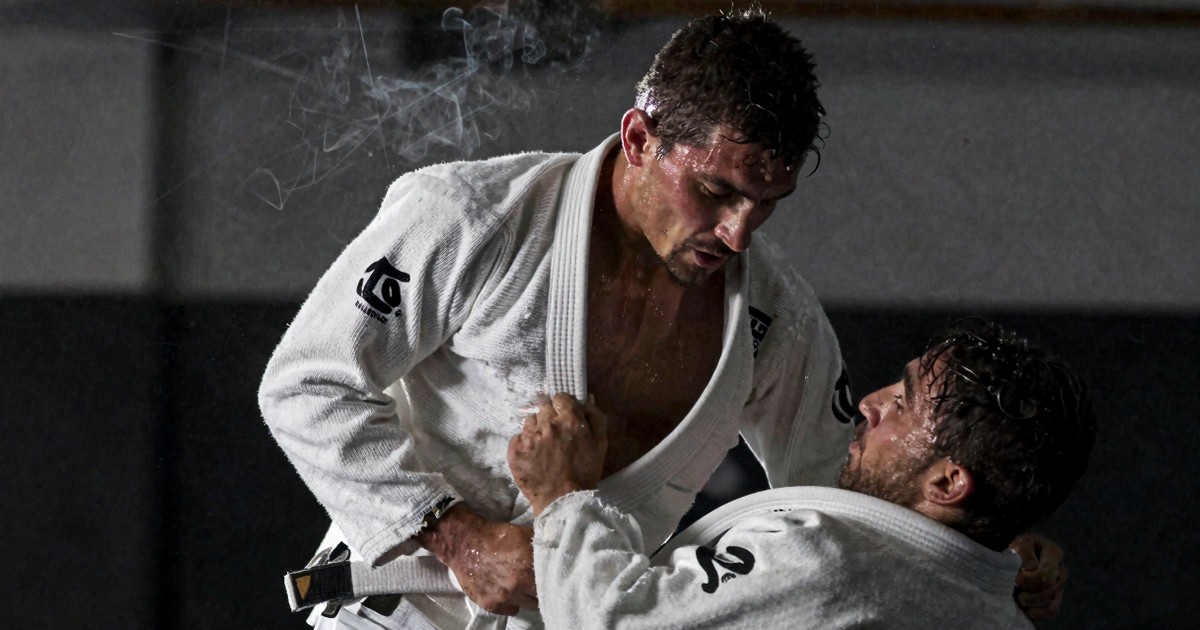
When I invert, I'm folding my legs up over my head and placing the back of my neck on the mat. My full body weight is now resting on the cervical spine. The opposing wrestler or grappler is standing. They're far heavier than me. If they decide to drop their weight forward—intentionally or accidentally—my neck absorbs everything.
Here's what happens in a controlled drill: this is a posture you can come out of. The escape is smooth. The neck is loaded briefly, and then unloaded.
Here's what happens in a live match: adrenaline, intent, and gravity. The opposing grappler is often doing the exact thing that makes this catastrophic—dropping down and forward. The neck is loaded. The neck stays loaded. The opponent is also fighting the submission at the same time, which means the rotation, the torque, and the axial loading are all happening simultaneously.
That's the paralysis risk. That's not a hypothetical. There are documented cases of grapplers and wrestlers suffering cervical injuries from exactly this kind of dynamic loading. The neck is not designed to take axial loads while the body is inverted. The vertebrae don't love it. The spinal cord doesn't love it. The muscles that should be protecting the spine are stretched, not contracting.
So when my coach yells at me, he's not being dramatic. He's being a coach.
Why Smaller Grapplers Take These Risks
If you've spent any time rolling with people who outweigh you by 30, 50, or 80 pounds, you already know the math. The submission the bigger person is hunting—usually a guard pass, a takedown, or a heavy top-position finish—becomes available to them almost by default. Gravity is on their side. Leverage is on their side. The referee's scorecard is on their side.
If you play it safe, you lose.
That's not a motivational line. That's just the data. Playing defensive jiu-jitsu against a heavier opponent almost always results in a slow, suffocating loss. The clock runs out. Your gas tank empties. You get crushed under side control until the referee stops the match.
The only path forward is to attack. Often. Earlier. And from positions that look completely insane to anyone watching from the outside.
That's what inverting is. That's what flying triangles are. You take a position where, biomechanically, you should be dead, and you turn it into a submission opportunity. You turn the danger into the angle. You turn the weight distribution that should kill you into the weight distribution that strangles them.
The Smaller Grappler's Calculation
- Risk of safe play: 100% chance of losing, with cumulative damage from being crushed.
- Risk of dangerous attack: Some percentage of serious injury, some percentage of winning, and a lot of uncomfortable moments in between.
- Optimal strategy: Manufacture the moments where you are in a better position than the other person.
Inverting is one of the ways I manufacture those moments. I can sit on my back, hide my legs, and wait for a bigger opponent to make a mistake. But "waiting" doesn't really work against pressure players. They don't make mistakes. They slowly, methodically, inexorably advance their position until the referee stops the match.
So I create the mistake. I create the angle. I create the chaos. I launch myself into a position where my neck is the entire foundation of the submission, and I trust that the technique will finish before the loading finishes me.
What My Coach Is Actually Saying
I want to be fair to my coach. He's not yelling at me to be a jerk. He's yelling at me because he's been around long enough to see what happens when the bet goes wrong. He's seen bigger grapplers slam down. He's seen necks get twisted. He's seen careers end.
When he yells, he's saying: "I understand why you're doing it. I also understand the consequences. And I want you to keep doing it consciously, not reactively."
That's the part I think a lot of people miss about coaching. The coach isn't there to tell you what to do. The coach is there to make sure you understand what you're doing while you're doing it.
I take that part seriously. I do think about the risk. I do visualize the worst-case scenario. I do plan my escape from the inverted position before I commit to it. And I do, occasionally, choose not to take the risk—usually when the match is already lost, or when the opponent is so much heavier that the math doesn't work.
But when the math does work—when the opponent is just heavy enough to be a problem, just tired enough to make a mistake, just unbalanced enough that my inversion becomes a real threat—I'm going to take the shot.
The Line Between Risk and Stupidity
I think about this a lot. There's a difference between calculated risk and plain old stupidity. The difference, as far as I can tell, is preparation.
If I haven't drilled the inversion, if I don't know the escape, if I haven't thought about what happens when the bigger person drops forward, then I'm being stupid. I'm gambling my neck on a coin flip.
If I have drilled it, if I do know the escape, if I have thought about the worst-case scenario, then I'm taking a risk. A real, scary, possibly-paralyzing risk. But a risk.
The goal of training is to move as many decisions as possible from the second category to the first. Drill the technique. Drill the escape. Drill the contingency. Drill the contingency to the contingency. Then, when the match is live, the only thing left to do is execute.
That's the version of BJJ I want to practice. The version where the risk is real but the choice is informed.
The Real Question
The question I keep getting asked is: "Is it worth it?"
Honest answer: I don't know yet. I haven't been paralyzed. I haven't been seriously injured. I'm still rolling. I'm still competing. I'm still throwing my entire body weight onto my neck and hoping the technique finishes before the loading does.
I tell myself it's worth it because the alternative is to lose. I tell myself it's worth it because the bigger opponent is going to win the position game if I don't disrupt it. I tell myself it's worth it because the submission is right there, and the only way to get it is to commit fully.
But I'm also aware that the body keeps a ledger. Every inversion is a line item. Every neck load is a line item. Some days the ledger is fine. Some days it isn't.
So I keep drilling. I keep tapping early when something feels wrong. I keep listening to my coach yell at me, even when I'm already upside down and the technique is already committed. And I keep taking the risk. Because the only thing worse than losing the match against a bigger opponent is knowing I never really tried.
The risk of paralysis is real. The risk of never testing yourself against someone bigger is also real. I made my choice. My coach made his. The match will tell us who was right.
Continue the training story
Put this BJJ story in the context of the full training record
See the belt timeline, competition notes, and the videos behind the written analysis.