Why Bigger Grapplers Shouldn't Always Wrestle Up
Critiquing larger grapplers for not wrestling up against smaller, technical partners misses the point of safe training. Strategic seated play is often risk management, not laziness.
I want to talk about a take I keep seeing in the BJJ comment sections, and I want to push back on it hard. The take goes something like this: if a bigger, more muscular grappler refuses to wrestle up against a smaller, more technical opponent, they're being cowardly, lazy, or somehow dishonoring the art. Specifically, people have been hammering Dr. Mike Israetel for sitting instead of standing against someone like Nicky Ryan. And I think that take is, frankly, wrong in ways that matter.
Let me explain why, because this isn't really about Mike or Nicky. It's about a culture problem in how we judge bigger training partners.
The Physics of Being Big on the Mats
Let's be honest about something that is true even if it's uncomfortable to say. At a certain size, you cannot move the way a smaller grappler can. That isn't a moral failing. It's not a flexibility issue, and it's not a conditioning issue. It's straight-up physics. Your center of gravity is higher, your limbs have more mass, your inertia is greater, and the feedback loop between your brain and your body is just slower because there's more body to control.
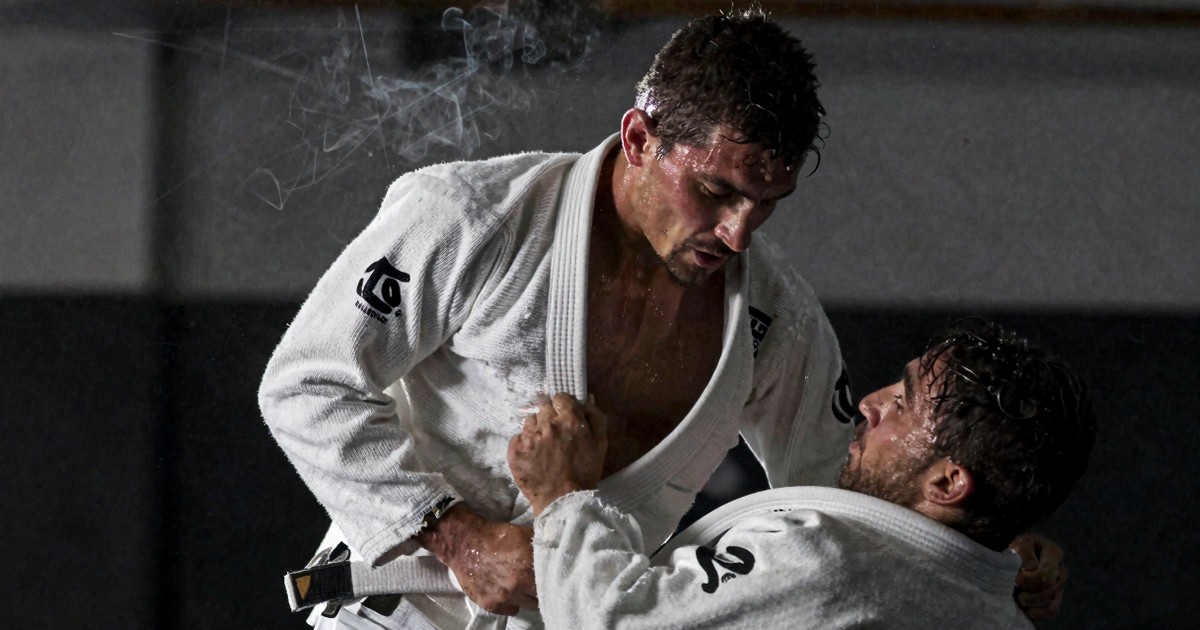
Now take that reality and put it in the specific context of a wrestle-up against someone like Nicky Ryan, in a room full of monsters who treat Nicky like a little brother they would absolutely throw down for. If you are a big person and you attempt a sloppy, off-balance wrestle-up, and you fall — not get taken down, but fall, like a tree — there is a non-trivial chance you land on your training partner in a way that breaks something. A collarbone. A rib. An arm. A face. Something. The same body that makes you hard to submit makes you hard to control when gravity takes over.
This isn't speculation. Anyone who has trained with someone significantly bigger than themselves has felt what happens when a big person loses balance. It is not a fun experience for the person underneath. The sheer force involved can be overwhelming, leading to joint hyperextension, impact injuries, or crushing pressure. This is not a critique of technique; it's a fundamental aspect of mass and momentum. When that mass is uncontrolled, the potential for harm escalates dramatically.
Choosing Safety Over Spectacle
The argument I keep hearing is that the bigger grappler should "suck it up" and wrestle up anyway, because that's what a real competitor would do. And in a real competition, sure, fine — sign the waiver, take the risk, do the thing. But we are talking about training. Training partners are not opponents. Training partners are not there to absorb the consequences of your compromised movement patterns. They are also not there to prove to you that you are tough.
When I choose to sit and play guard instead of wrestle up, I am making a decision that considers three things:
- The skill gap between me and my training partner
- The size gap between me and my training partner
- The environment I am training in, including who's watching and the cultural norms of that gym
If the skill gap favors the smaller person dramatically, and the size gap favors me dramatically, then the most dangerous version of me is the version that is moving erratically. A controlled seated game is not laziness. It is risk management. This isn't about avoiding hard work; it's about intelligently applying effort where it's most productive and least likely to cause injury. Playing a strong, controlled seated guard can still present significant challenges and opportunities for skill development for both parties, without the undue risk associated with a poorly executed explosive movement from a larger athlete.
The Fatigue Angle Nobody Wants to Admit
Here is the part of the take that I find particularly annoying, because the same people making the critique don't want to hear the obvious follow-up: sometimes I am too tired to wrestle up. Not "don't want to." Too tired. Too cooked. My coordination is gone, my explosiveness is gone, and if I try to stand up right now against a skilled opponent, I am going to do something stupid.
This is true for me. I will admit it. I am a bigger grappler, and there are rounds where my gas tank is empty and I am consciously choosing not to wrestle up because I know the version of me that tries to wrestle up at round four is a danger to the person across from me. That is not a lack of fitness. That is pattern recognition from years of training. I know what my clumsy looks like, and I know when it's coming. Pushing through extreme fatigue when your motor control is compromised is a recipe for disaster on the mats.
The same logic applies to anyone, including someone at Mike's level. Bigger people accumulate fatigue in different ways than smaller people. Their wrestling up demands more energy. Their margin for error is smaller. When they are tired, their wrestle-up gets worse at a faster rate than a lighter athlete's. Pretending that's not real is just refusing to do math. The energy expenditure for large athletes to execute dynamic movements like wrestling up is exponentially higher, and this deficit is amplified significantly when fatigue sets in. Their technique might degrade faster under duress, making a controlled seated approach a more pragmatic choice.
The Unfair Critique Hiding Inside the Take
What I really want to call out is the implicit message in this critique. The implicit message is that if you are a bigger grappler and you don't move like a smaller grappler, you are somehow failing at jiu-jitsu. You are "too big." You are "clumsy." You are "not in the kind of shape you should be in."
That is an unfair thing to say, and it reveals a bias in how our community talks about body types. We celebrate big wrestlers who muscle through guys in the heavyweight division and call them legends. We criticize the same kind of athlete when they refuse to wrestle up at training against a much smaller partner. We want them big enough to be impressive and small enough to be graceful. Both things cannot be true at the same time. This cognitive dissonance highlights a fundamental misunderstanding of biomechanics and athletic expression across different physiques.
If you want a bigger grappler who wrestles up like a featherweight, you are describing a person who doesn't exist. The qualities that make someone excellent at wrestling up from seated against a smaller, more technical opponent are, by definition, the qualities that smaller grapplers have. Those qualities are partially a function of size. Asking a bigger grappler to perform them at the same level is asking them to be something they structurally cannot be. It's akin to asking a marathon runner to excel at Olympic weightlifting without acknowledging the inherent differences in their training and physical adaptations.
A Better Way to Think About It
Here is the framework I'd encourage people to use the next time they want to criticize a bigger grappler for not wrestling up. Ask three questions instead of making a take.
1. Is my training partner tired, or am I asking them to risk injury to satisfy my ego?
If the answer is the second one, sit down yourself and work your own game. There is no shame in playing open guard from the top. Recognizing and respecting the limits of your training partners, especially concerning fatigue and injury risk, is paramount to fostering a positive and sustainable training environment.
2. Would a wrestle-up attempt at this moment actually be good for both of us?
If the bigger grappler is gassed, off-balance, or in a position where a fall is likely, the answer is no. A scramble that ends with a 250-pound adult falling on a 150-pound training partner is not a productive training moment for either person. Safety and mutual benefit should always be the primary considerations in training rolls.
3. Am I critiquing their decision, or am I critiquing their body?
This is the uncomfortable one. If the take boils down to "you should weigh less," say that. But at least be honest about what you are actually saying. Don't dress up a body-type preference as a critique of character or work ethic. Honest self-reflection about underlying biases is crucial for constructive dialogue within the grappling community.
Closing Thoughts
The mats are a place where we are supposed to be honest with each other, and that includes being honest about what different bodies can and cannot do safely. Bigger grapplers owe their training partners control, predictability, and an honest attempt not to hurt them. Smaller grapplers owe their bigger partners grace when those bigger partners choose a safer option for the round. This mutual respect and understanding are the cornerstones of a healthy training culture.
Sitting to play guard is not a moral failing. It is a decision. Sometimes it is the wrong decision. Sometimes it is the right one. And sometimes — especially when the size gap is large and the skill gap goes the other way — it is the most respectful thing a bigger training partner can do for the smaller person across from them. Prioritizing the well-being and continued participation of all training partners ensures the longevity and integrity of the jiu-jitsu community.
The next time you see a bigger grappler decline to wrestle up, before you reach for the hot take, ask yourself whether you'd actually want to be under that person if they tried and failed. The answer usually settles the debate. This simple thought experiment can foster empathy and a more nuanced perspective on the complexities of grappling with diverse body types and skill levels.
Continue the training story
Put this BJJ story in the context of the full training record
See the belt timeline, competition notes, and the videos behind the written analysis.