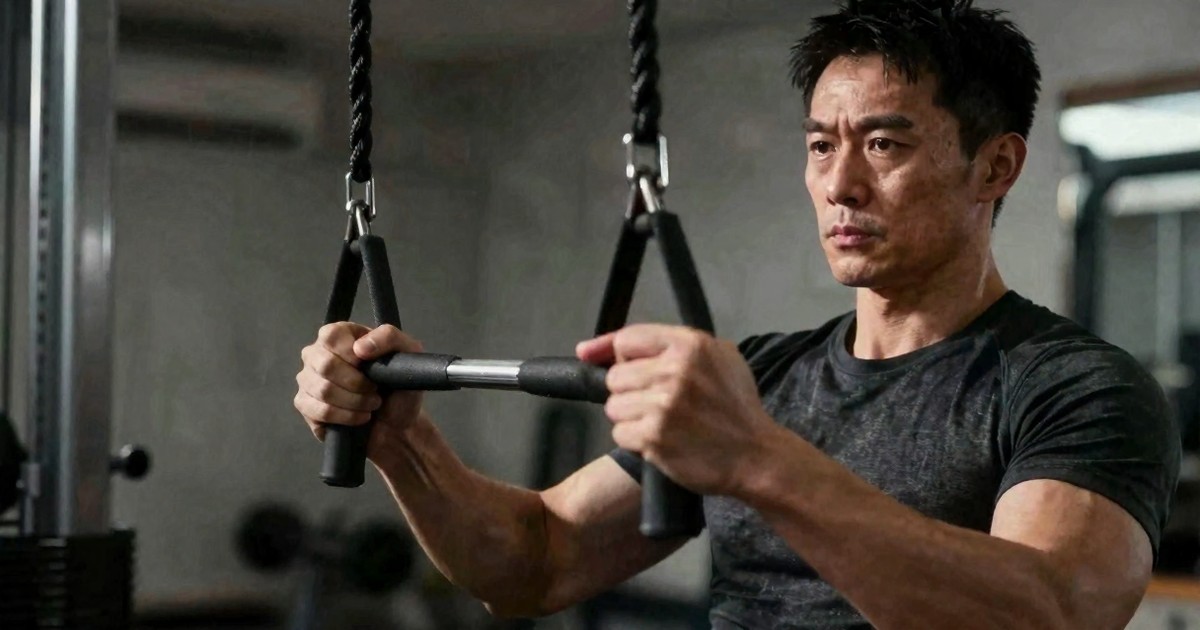
Train Around Elbow & Wrist Pain Without Losing Progressive Overload
My three-stage system for training around elbow and wrist pain: VersaGrips, joint braces, and a heated massager, without sacrificing progressive overload.
A viewer asked how to continue training with chronic elbow pain when they already possess the necessary equipment. The straightforward answer involves modifying the joint angle, adjusting the rep tempo, and incorporating three external supports: grip aids, joint braces, and a heated massager. This approach ensures you don't have to sacrifice progressive overload. Here's the exact progression I utilize for my own persistent wrist pain, which has suffered multiple fractures and won't fully heal without surgery that I continue to postpone.
Step 1: Adjust Joint Angle First
If you experience elbow discomfort during bench presses, the initial step is to evaluate your elbow positioning. This was demonstrated in the video using Power Blocks set to 35 lb for visibility:
- Pressing with flared elbows places significant torque on the elbow joint, especially with heavier loads.
- Tucking the elbows down and back, then rotating them inward during the press, alleviates this torque.
- At 35 lb, either method feels acceptable. However, at 75–80 lb, the flared position exacerbates my elbow pain. I must then bring my elbows in and rotate them over during the press.
If pain persists even after adjusting your pressing form, the next factors to consider are tempo and the resistance curve.
Step 2: Utilize Eccentric Mode and Slow Tempo on Cable Machines
The viewer specifically inquired about the effectiveness of smart cable machines. The honest assessment is that their benefit is conditional:
- Simply using the same exercises and pulling motions with a cable machine won't magically resolve underlying issues.
- However, switching the machine to eccentric mode and employing a three-second lowering phase increases the eccentric resistance relative to the concentric. This alters the tissue being loaded and is often more comfortable for aggravated elbows.
- I consistently use eccentric mode for every lift on my Speediance machine for this precise reason.
The key takeaway is that the equipment itself is secondary to proper positioning and tempo.
Rethinking Extended Deloads
I elaborated in the video on my disagreement with the advice to "plan a 1-month deload." In my view, this approach is misguided. Training should integrate with your life. If a particular month involves travel or necessitates a recovery focus, that's a natural adjustment. However, pre-scheduling a month off simply because it was recommended online undermines the consistency crucial for most gains. I recently had a month with minimal training due to an ankle fracture sustained before a cruise, and the gym's inconvenient location on the ninth floor. This was a consequence of life events, not a planned deload.
My Three-Stage System for Chronic Joint Pain
For persistent, nagging elbow or wrist pain, I employ a three-tiered approach. Each stage introduces additional support without necessitating a reduction in intensity or compromising progressive overload.
Stage 1: VersaGrips – An Effective and Affordable Solution
Initially, I experimented with less expensive imitation versions. However, the leather on every pair I tried was too slippery, and they failed to provide adequate wrist support. A fellow BJJ practitioner at my gym offered me his unused genuine VersaGrips, which I purchased from him at a price close to retail.
Their benefits for me include:
- Providing a slight clearance around the bar, preventing the wrist from being forced into full extension.
- Offering a tactile grip that helps maintain a neutral wrist position under heavy loads.
- When combined with the tucked-elbow press technique, the overall movement feels significantly smoother and more controlled during the top portion of a set.
If you can locate a high-quality knockoff that matches the leather standard of genuine VersaGrips, it could offer a more budget-friendly option. My personal experience, however, led me to invest in the authentic product.
Stage 2: Wrist Guards and Braces – Graduated Support
When VersaGrips alone are insufficient, I escalate by using a selection of braces, choosing based on the specific needs of my joint on any given day:
- Light Support: A simple slip-on sleeve for minor flare-ups.
- Medium Support: A wraparound guard offering stability during a training session.
- Maximum Support: A rigid thumb-spica brace for days when my wrist is particularly aggravated.
Last year, I utilized the most supportive brace for the majority of the Arnold Sports Festival. The principle is similar for elbows: an elbow sleeve that stabilizes the joint at a consistent angle. The objective isn't merely compression; it's to provide stability, preventing the joint from constantly adjusting its position under load.
I avoid wearing these preemptively. They are reserved for situations where my joint is already signaling discomfort.
Stage 3: Heated Wrist Massager for Post-Workout Recovery
The most challenging scenario arises when I am caught in a wrist lock during jiu-jitsu. Due to my wrist's reduced extension capability, I often tap sooner than I'd prefer, and the discomfort typically lingers into the next day. In such instances, I turn to a heated, vibrating wrist massager, similar to those from Alljoy.
Its effectiveness stems from:
- Applying heat and vibration to the joint for approximately 30 minutes, often during my lunch break.
- Resulting in a noticeably improved joint condition the following morning compared to if I hadn't used it.
- While roller balls can offer some relief, they require manual effort. The automated massager allows me to remain productive.
I haven't encountered an elbow-specific version of this massager. However, the underlying principle of using automated heat and mobilization to facilitate quicker return to training remains applicable.
A Note on Smart Gyms
The original viewer question evolved into a broader discussion about smart gyms equipped with Tonal-style arms. I currently train on a Speediance and closely monitor offerings like the AEKE S1 Pro and Fit Hub Titan Pro. For those comparing them based on raw resistance:
| Machine | Max Resistance | Notes from the video |
|---|---|---|
| Tonal 2 | 250 lb | Cable is frayed on my old unit; arms have batteries that die silently. |
| Speediance | 260 lb | Cable system is fine; retraction got slower after updates but has improved. |
| Fit Hub Titan Pro | 264 lb | Tonal-style arms; going through a rebrand. |
| AEKE S1 Pro | Not stated in video | Tonal-style arms; has a published roadmap. |
Personally, I will not consider replacing my Speediance until a machine offers over 300 lb of resistance. The difference between 260 lb and 264 lb is insufficient to warrant an upgrade. Software capabilities are another crucial factor. While Speediance's V3 addressed the bar-tilt bug I encountered, it still lacks the ability to run custom workouts with a partner—a feature Tonal has offered for years and which I utilize weekly.
My Current Training Status
I am presently in a cutting phase, aiming to reduce my weight from 240 lb to 210 lb, a process I undertake annually with heavier training in the winter and leaner periods in the summer, focused on muscle retention and slight gains. Currently, my training priorities are jiu-jitsu and outdoor running, which are seasonal choices rather than a planned deload. My lifting regimen has taken a temporary backseat.
The three-stage system—adjusting angle, modifying tempo, and layering grip aids, braces, and massagers—enables me to maintain progressive overload in my program, even when my joints are not at peak condition. For acute or persistent pain, consulting a medical professional is advisable. However, for chronic, nagging discomfort, this integrated approach has allowed me to train consistently for years.
The complete walkthrough, including the dumbbell form demonstration and brace stacking techniques, is available in the original video.
Keep comparing
Make the next smart-gym decision with the full picture
Move from one review into model comparisons, real lifting data, and the matching video demonstrations.
Related Posts
Progressive Overload: The 7 Methods That Stop Strength Plateaus
Progressive Overload Is King: Why I Lean Toward Lower-Volume, Harder Sets