How I Set My Top 3 Fitness Priorities Each Year (2026 Edition)
Setting yearly fitness priorities helps clarify what to embrace and what to decline. Here is why focus matters more than a long list of goals when navigating injury recovery.
Every January I sit down and write the same thing: a short list of what actually matters for the next twelve months. Not a wishlist. Not a "hit every muscle group twice a week" plan. A short list — three things, ranked — that tells me what to say yes to and what to say no to.
The title of this post is "My Top 3 Fitness Priorities for 2026," but the honest truth is that only one of them really drives my day-to-day decisions. The other two are there because I know myself. If I do not write them down, they will quietly consume the year.
Priority #1: Get back to running
This is the one that is actually at the top. There is a four-mile race on the calendar for this year, and on paper that does not sound like much. Four miles is not far. Most runners would call it a warm-up.
But I have not run seriously in years. I have been dealing with an ankle injury that has me deconditioned in a way I am not used to. The combination of the injury, the time off, and the fact that I have not pushed a pace in a long time makes this a legitimate primary objective — not a casual goal.
That means the bulk of my training time, my recovery budget, and my willingness to feel uncomfortable in 2026 is going to running. Not everything else gets cut, but everything else gets scheduled around it.
Why a short race is the right re-entry
Four miles is short enough that I can actually finish it on Day 1 of training, even in my current shape. That is the point. I need a goal that I can show up to, not one that requires a perfect build-up just to toe the line.
Longer events are tempting, but for a return from injury and time off, a four-miler is the right size: real enough to demand training, short enough to respect the ankle.
Priority #2: Jiu-jitsu stays on the list — but lower
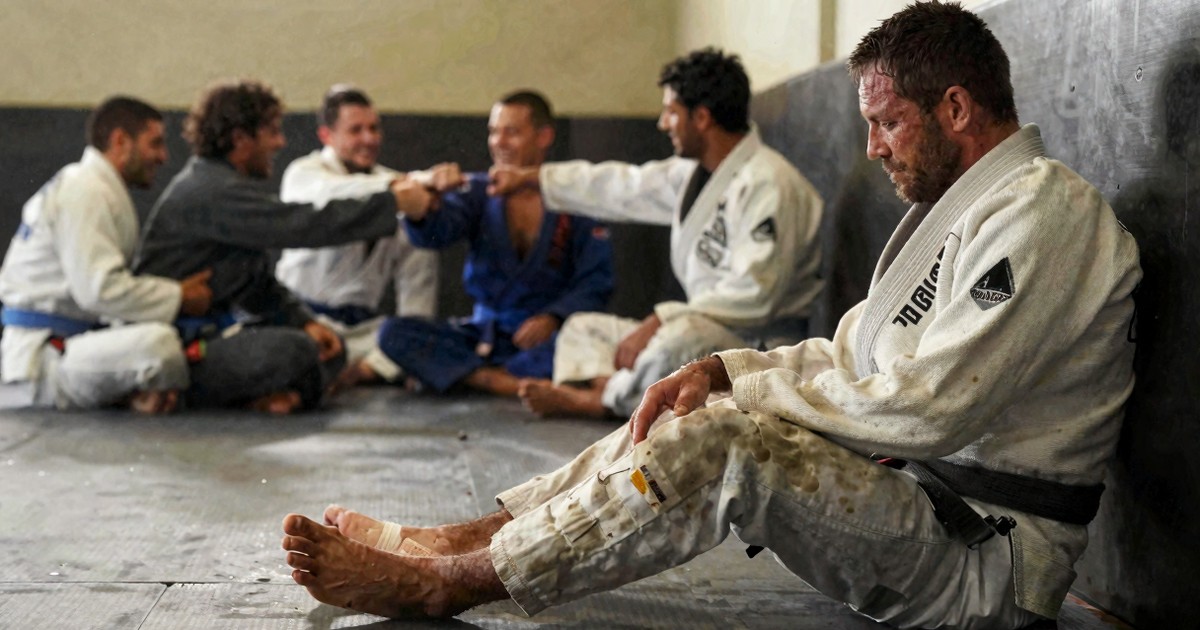
Sometimes jiu-jitsu is at the top of my list. This year it is not. But I am not dropping it.
In 2023, the top of the list was lifting and losing weight. I did almost no running and almost no jiu-jitsu. In fact, I took most of the winter off. I might have shown up once every two weeks, and honestly, when I did show up, I performed terribly. I might as well have not gone.
That experience taught me something useful: when a priority gets bumped, the things that get bumped do not just pause gracefully. They decay. My BJJ did not stay at the level I left it. It dropped. And the drop was bigger than I expected.
So BJJ stays on the list, but lower. That means I show up with a minimum cadence I will not negotiate, but I am not chasing progress there this year. I am trying to keep the floor from falling out.
The two-week trap
Showing up once every two weeks is the worst of both worlds. You are sore enough to be bad. You are fresh enough to think you should be good. You are invested enough to feel bad about the investment. It is a trap.
This year, the rule is simple: if I am not going often enough to improve, I am going less often. Either I am training jiu-jitsu, or I am taking a real break. No half-attendance.
Priority #3: Keep the lifting habit alive
The third priority is structural. It exists to keep the thing I built in 2023 from disappearing.
In 2023, lifting and losing weight were the headline. I made progress. The cost was that everything else fell off the calendar. That is a trade I am willing to make sometimes, but I do not want to make it every year.
This year, lifting gets a maintenance role. Not a transformation role. Not a PR role. A "keep the muscle, keep the routine, do not let the habit break" role. That usually means a shorter, more focused session two or three times a week, no programming gymnastics.
Why I write the list down
The point of the list is not to motivate me. It is to defend me from myself.
Without a written priority list, every shiny new thing has equal weight. A new gadget, a new class, a friend who wants to train at a time that conflicts with the schedule — they all feel like reasonable yeses. With the list, I have a default answer: does this serve a priority, or does it compete with one?
That is the framework. It is not fancy. It does not have a clever acronym. It is three lines on a page, ranked, reviewed every few months.
What "deconditioned" actually feels like
I want to name this because I think it helps anyone coming back from injury or a long layoff.
Deconditioned does not mean "a little out of shape." It means your baseline has moved. Easy efforts feel harder. Recovery takes longer. Sleep matters more. The body is honest in a way that ego is not — it tells you, in plain language, what you have stopped doing.
The right response is not to fight that. It is to accept a lower starting line and build from there. The four-mile race exists in part because it is small enough to train for from a realistic starting point.
The honest part
If you have watched me for a while, you know I am not a "do everything every day" person. I am a "pick the thing and protect it" person. Some years the thing is jiu-jitsu. Some years it is lifting. Some years it is a race.
This year the thing is a four-mile race that I am not ready for yet, run on an ankle that is not fully healed, after years away from running seriously. That is the work.
The other two priorities are there to keep the rest of the house from collapsing while I do it.
That is the list. That is the year.
Choose the next view
Move from the story into the underlying training data
Explore the weekly plan, video library, and the best place to start with the site.
Keep Reading
Related Posts

Beating the 155 BPM Wall: How I Fixed My Post-Hospitalization Running
Why I Still Train Jiu-Jitsu Despite Injuries and a 70lb Weight Cut