Unlock More Strength With Eccentric Mode on Speediance
Eccentric mode can make familiar movements feel dramatically more effective without changing your whole program. Here is how to use it well on Speediance and why small setting choices matter.
If you want to get more out of your training without overcomplicating your workouts, eccentric mode is one of the most useful features on the Speediance. It is a simple adjustment, but it can have a major impact on how hard a movement feels, how much control you build, and how much stimulus you get from each rep.
That is part of what makes digital resistance different from old-school plates and selectorized stacks. You are not limited to one fixed resistance profile for every exercise. Instead, you can shape how the load behaves throughout the rep. When you use that well, training feels more intentional. When you ignore it, you miss one of the biggest advantages of the machine.
This is why eccentric mode deserves more attention. It is not a flashy gimmick. It is a practical setting that can improve familiar movements, help you create more challenge without automatically adding more concentric load, and make your programming feel smarter with very little extra effort.
What Eccentric Mode Actually Does
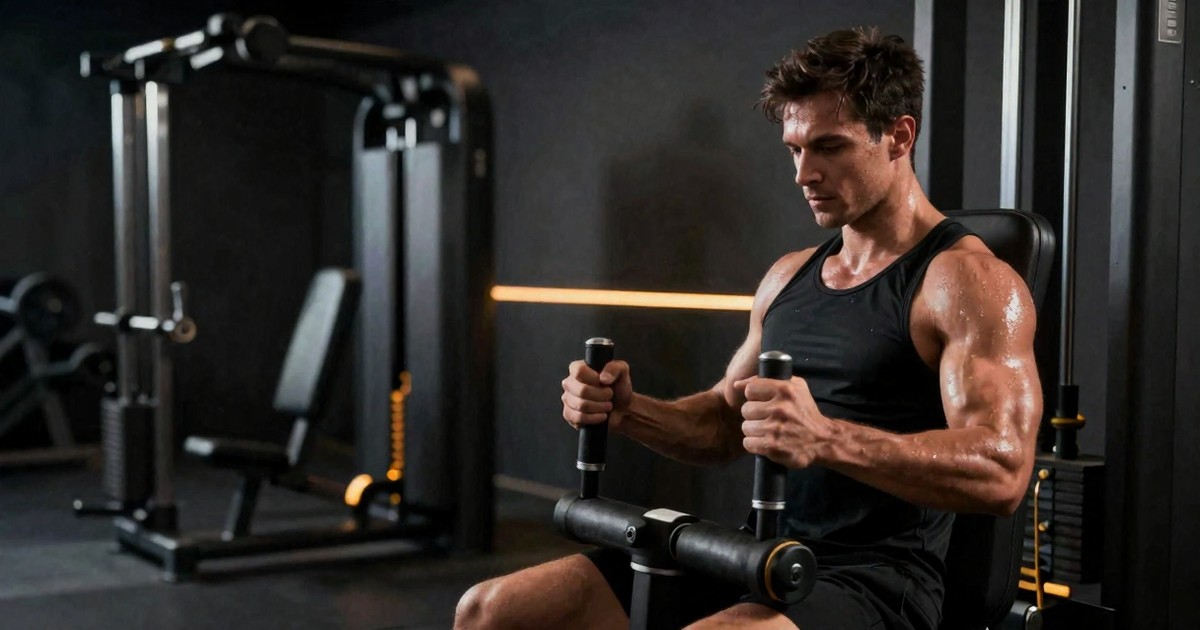
Eccentric mode increases the challenge during the lowering phase of a movement. In strength training, that lowering phase is called the eccentric portion of the rep. If you are doing a row, the pull toward your body is the concentric phase. The controlled return is the eccentric phase. In a press, pushing away is concentric and lowering back down is eccentric. In a squat, standing up is concentric and descending is eccentric.
That distinction matters because most people are stronger eccentrically than they are concentrically. You can usually control more load on the way down than you can lift on the way up. Traditional weights do not adapt to that very well. A dumbbell weighs what it weighs. A barbell weighs what it weighs. Digital resistance can do something more useful: it can challenge each part of the rep differently.
That means eccentric mode is not just about making an exercise harder. It is about matching the resistance to what your body can actually handle during different phases of the movement. When that happens, reps often feel smoother, more demanding, and more productive at the same time.
Why It Feels So Different
The first time you use eccentric mode on an exercise you already know well, the movement often feels immediately different. The rep does not just end once you finish the hard part. You still have to own the lowering phase. That changes the character of the set.
Instead of treating the descent or return as dead space between efforts, you turn it into work. That means more time under tension, more focus on positioning, and often more muscular fatigue even when the exercise itself has not changed. The movement becomes less about simply completing reps and more about controlling the entire rep from start to finish.
For many lifters, that can be a great way to increase training quality without constantly chasing higher numbers. If you are already near your practical limit on a movement, or if your joints do not love endless increases in load, eccentric emphasis gives you another path forward.
The Visual Cue That Makes Programming Easier
One small but useful detail with Speediance is the visual change when eccentric mode is enabled. Once the setting is turned on and the workout starts, the exercise displays a different icon to indicate the active mode.
That may sound minor, but it matters. In real workouts, convenience matters. If you are moving through a session with multiple exercises, different resistance modes, and a limited amount of rest, you do not want to stop and second-guess what is active. A clear visual cue reduces friction. It helps you confirm at a glance that the machine is doing what you expect it to do.
This is one of the underrated strengths of a connected training platform. Good software should remove confusion, not add to it. When a machine gives you instant confirmation that a movement is set up the way you intended, your workouts feel smoother and more trustworthy.
Why Saved Movement Settings Matter
One of the biggest practical advantages of Speediance is that the machine can remember how you have used a movement before. That matters more than many people realize.
When you find a setup that works, you do not want to rebuild it from scratch every session. You want the machine to preserve that context. If you consistently use a specific exercise with eccentric emphasis, saved preferences can make your future workouts faster and more consistent. Instead of reprogramming the movement every time, you can step in and get to work.
That is not just a convenience feature. It supports better training. Consistency is easier when the machine remembers your intent. Your sessions feel less random. You spend less time tapping through settings. You are more likely to repeat the version of the movement that actually works best for you.
For lifters who care about progressive overload and repeatable training quality, that is a big deal. A machine that stores context is more useful than one that only stores exercise names.
The Important Warning About Customize
There is also a clear caution here: be careful with the customize option. Customization can be valuable, but it should not be treated casually.
If you jump into custom settings and start changing movement parameters on the fly, you may unintentionally overwrite details that were helping your workouts stay consistent. That can include resistance behavior, mode selection, rep structure, and other preferences that may have been built up over time.
The frustrating part is that these changes do not always feel significant in the moment. You think you are making a quick one-off adjustment, but you may actually be changing the way the movement behaves the next time you return to it. Then a familiar exercise suddenly feels off, and you are left wondering why.
That does not mean you should never customize anything. It means you should do it with intent. If you know exactly why you are changing a movement and you want that new setup, great. If you are just poking around mid-workout, it is worth slowing down.
- Use your normal movement setup when it already works well.
- Make custom changes on purpose, not out of boredom.
- Assume your edits may matter later, not just in the current session.
- If you find a great setup, preserve it instead of endlessly tweaking it.
Consistency Beats Constant Tinkering
This points to a bigger training principle that goes far beyond Speediance: consistency usually beats constant tinkering.
Smart gyms are exciting partly because they offer options. You can adjust modes, resistance profiles, workout structures, rep targets, and movement behaviors in ways that are impossible with most traditional home gym equipment. That flexibility is useful, but only when it supports your goal. If it turns every session into a settings experiment, it becomes noise.
The best setup is not the one with the most complexity. It is the one you can use consistently enough to drive progress. If eccentric mode improves a row, press, curl, squat, or hinge variation for you, that is valuable. You do not need to reinvent the wheel every workout. Repeat what works long enough to benefit from it.
This is especially important for home gym lifters, who often train without the social structure of a commercial gym. Your environment already gives you freedom. The challenge is using that freedom to create better habits, not more distractions.
Progress Is Not Just More Weight
One reason eccentric mode is so useful is that it broadens how you think about progression. A lot of people still view progress too narrowly. They assume the only real sign of improvement is adding more weight. That is one valid form of progress, but it is not the only one.
You can progress by adding a rep. You can progress by improving control. You can progress by reducing sloppiness at the end of a set. You can progress by keeping the same rep count while increasing the challenge of the eccentric phase. You can progress by making a familiar movement more technically honest.
That matters because not every training cycle should revolve around pushing maximum load. Sometimes the smartest change is increasing stimulus without increasing wear and tear. Eccentric mode gives you another lever to pull when straightforward load jumps are not the best option.
If a set suddenly feels harder because the machine is asking you to truly control the return instead of coast through it, that is not a flaw. That is the point.
Why Eccentric Training Deserves More Attention
If you have never intentionally used eccentric-focused resistance before, there are several reasons it is worth exploring.
- More time under tension: the rep does not end after the hardest push or pull.
- Better movement control: you have to stay connected to the exercise instead of switching off on the way back.
- A stronger training effect without automatic load jumps: that can be useful for both muscle-building and joint-friendly progression.
- More exercise variety: not by changing the exercise itself, but by changing how it challenges you.
- Higher-quality reps: you are more likely to respect tempo and positioning when the lowering phase matters.
For digital resistance machines, this is one of the biggest selling points. The hardware is only part of the value. The real advantage is that software can shape resistance in ways static equipment cannot.
Best Ways to Try It
If you want to test eccentric mode without overthinking it, start simple. Pick a movement you already know well. Use one where your technique is reasonably consistent and where you can clearly feel the lowering phase. Rows, presses, curls, split squats, and some hinge patterns are often good candidates.
Then pay attention to a few basic questions:
- Does the movement feel more controlled or just more chaotic?
- Can you maintain good positions through the full rep?
- Does the added eccentric demand improve the set, or does it overwhelm it?
- Does the machine remember your preferred setup the next time you use the exercise?
The goal is not to turn every exercise into an eccentric torture test. The goal is to identify where this mode adds useful stimulus and where a simpler resistance profile may be better.
Final Thoughts
Eccentric mode is a great example of what makes the Speediance more than just a cable machine with a screen. It gives you a smarter way to train, and when the machine remembers how you use a movement, it becomes even more helpful over time.
Just as important, it highlights a lesson many lifters need to hear: the best training tech is only valuable when it supports consistency. Use the features that improve your reps. Keep the settings that make your training better. Be careful with customization when you have already built something that works.
Sometimes the biggest upgrade is not a brand-new program or a dramatic jump in weight. Sometimes it is one well-chosen setting that makes every rep more effective.
Keep comparing
Make the next smart-gym decision with the full picture
Move from one review into model comparisons, real lifting data, and the matching video demonstrations.