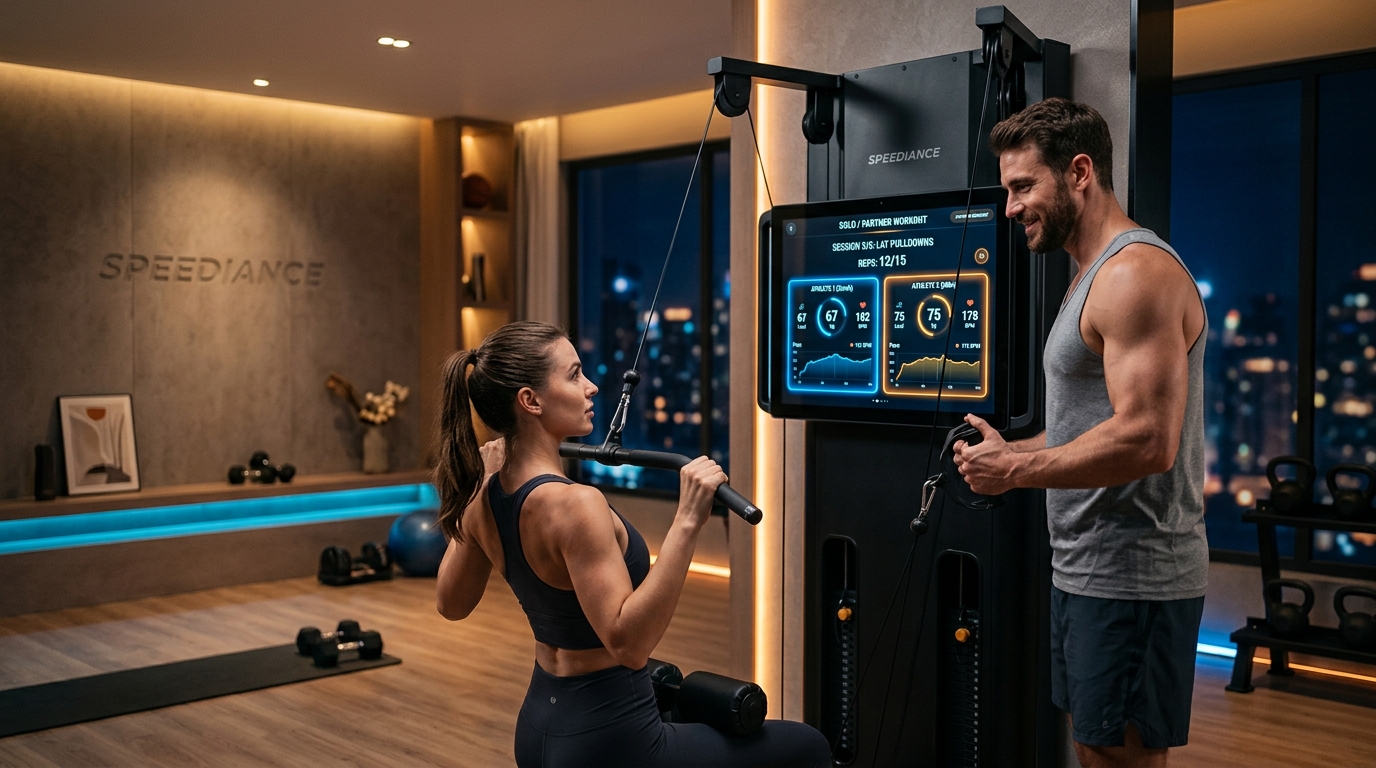
Speediance Platform Safety: Don't Drop It on Your Head
Learn how to safely handle the Speediance platform disassembly and why one-handing the unit is a subtle but significant strength milestone.
I was midway through taking the Speediance platform down for the first time when it finally clicked. The little graphic in the app — the one I had skimmed past on day one — was trying to tell me something important. I just hadn't slowed down long enough to listen. And what it was telling me, in the gentlest possible way, was: don't drop this on your head.
That's the spirit of today's post. It's not a deep-dive review or a transformation story. It's a field report from someone who has spent a lot of time around heavy, awkwardly shaped training tools, and who wants to make sure you don't learn this lesson the way I almost did — by accident, mid-movement, with a piece of high-tech machinery hovering over your face.
What the Graphic Actually Says
If you've used the Speediance Gym Monster platform, you've probably seen the disassembly animation. It shows two hands: one near a control button, the other supporting the weight of the platform as it folds or releases. The official method is strictly two-handed. Hand here, hand there, push, and the mechanism does the rest. The animation is smooth, clean, and looks incredibly easy, which is exactly why it's dangerous for the overconfident.
That's the safe default. It's the move the manufacturer wants you to make, and it's the one that works regardless of your current strength level. But here's the part I initially glossed over: if you're strong enough — and they specifically note the ability to hold roughly 30 pounds in one hand — you can manage it one-handed. The other hand stays free, often up by the control button, ready to hit the release or stabilize the unit as it comes down.
It's not required. It's not even recommended for beginners. It's just a more efficient version of the same move, available to anyone who has built the specific grip and forearm stability to pull it off without the unit oscillating or slipping.
Why This Matters More Than It Sounds
A home gym platform isn't a kettlebell. It doesn't have a ergonomically designed handle. It doesn't have a predictable center of gravity because of the internal motor and cable housing. When it comes off its mount or unfolds, it wants to fall, and it has enough mass behind that fall to ruin your week. We are talking about precision engineering mixed with gravity; it's a combination that demands respect.
Think about the geometry for a second. You're reaching up, or reaching across, to grip a piece of equipment that probably weighs more than the dumbbells most people warm up with. If your grip slips, or your timing is off by half a second, the platform doesn't politely slide down your arm. It drops. And where does it go? Straight toward the closest surface — which, given the angle you're working at, is very often your head, your shoulder, or your bare foot.
This isn't theoretical caution. It's the reason the two-handed method exists in the first place. The second hand isn't just for show or balance; it's the redundant safety system. If one hand fails, the second hand prevents a medical bill.
The Quiet Milestone of Being Able to One-Hand It
Here's where the lesson turns into something more interesting than a safety PSA. The comment about "if you can lift over 30 pounds" is doing more work than it looks like. In the world of BJJ or heavy lifting, 30 pounds is negligible. Most people reading this can deadlift that in their sleep. However, 30 pounds, held statically, at arm's length, in a pinch grip, with the weight oriented awkwardly? That's a different ask entirely.
It requires grip endurance. It requires forearm stability. It requires confidence in the hold while your other hand is busy navigating a touchscreen or a physical latch. The point isn't actually "can you one-hand the platform?" The point is what being able to do so tells you about your progress. If you've been using the Speediance consistently for a few weeks and your grip and shoulders have improved, this task becomes a small, incidental milestone.
Most strength milestones get celebrated loudly: a new deadlift PR, a strict pull-up, or a heavier bench. But a quieter milestone — being able to safely manage your equipment with one hand free — is also worth noticing. It's a sign the training is transferring into real-world competence, not just digital numbers on the screen.
Safety Protocol: Don't Rush It
Just because the option exists doesn't mean you should jump to it immediately. Follow these steps to ensure you keep your skull intact:
- Start two-handed: Every single time, until the movement is fully grooved. You're not losing anything by using two hands. You're gaining insurance.
- Watch the actual graphic: I mean it. Most of us skip tutorials, and that's how avoidable mishaps happen. The animation is short; watch it twice before you move the unit today.
- Clear your drop zone: Make sure there's nothing under you — no dumbbells, no pets, no children. If the platform does slip, you want a clear floor, not a tragedy.
- Build grip work: If you want to graduate to the one-handed version, you've effectively signed up for a pinch-grip program. Farmers carries, plate pinches, and dead hangs will pay dividends here.
- Test when fresh: Don't try the one-handed version for the first time when you're exhausted at the end of a 45-minute session. Try it after a light warm-up when your hands are steady.
A Bigger Note on Home Gym Safety
This post is about the Speediance platform, but the principle applies to almost every piece of home gear. Cable machines fold, benches tip, and adjustable dumbbells can drop plates if not seated correctly. The danger isn't usually the workout itself; it's the setup, the teardown, and the in-between moments when our focus drifts.
The fix is embarrassingly simple: slow down. Read the instructions the first time, not the fifth time after something breaks. Use two hands until one hand is provably enough. It isn't glamorous, and it won't make a highlight reel, but it's the difference between a piece of equipment that serves you for years and one that serves you a black eye on day two.
The Speediance platform is a genuinely good piece of training gear, and the engineering team clearly thought through the disassembly process. They gave us a two-handed default for safety and a one-handed option for those who grow into it. Our job is to respect that design, read the manual, and never find out what it feels like to drop 30 pounds of tech on our heads.
Keep comparing
Make the next smart-gym decision with the full picture
Move from one review into model comparisons, real lifting data, and the matching video demonstrations.
Keep Reading
Related Posts
Arnold Classic, Speediance Bugs, and a Public Correction
Speediance Ring Clip vs Bare Ring: Which Actually Works?