AEKE K1 vs Speediance: Why the Built-In Camera Wins
The AEKE K1's skeletal tracking camera changes the smart home gym game. Here is what 6 months of use reveals about how it stacks up against Speediance.
Short answer: if form-tracking camera quality and zero-subscription software are deal-breakers for you, the AEKE K1 beats Speediance in the ways most home lifters actually care about. After six months of daily use, Joel's verdict on the K1 is clear: the integrated skeletal tracking camera at the base of the unit is the single biggest advantage over Speediance, Tonal, and anything else that leans on your phone's camera.
This breakdown comes from a hands-on conversation with Joel on Toby on Fitness Tech, where he walks through the screen, the AI coach, the deployment mechanism, and the quirks nobody mentions in launch reviews. When you are spending thousands of dollars on a digital weight system, the difference between a machine that helps you lift and a machine that gets in your way is usually found in the software friction and the physical setup. In this showdown, the AEKE K1 targets the friction points that have plagued the first generation of smart gyms.
The camera is the whole story
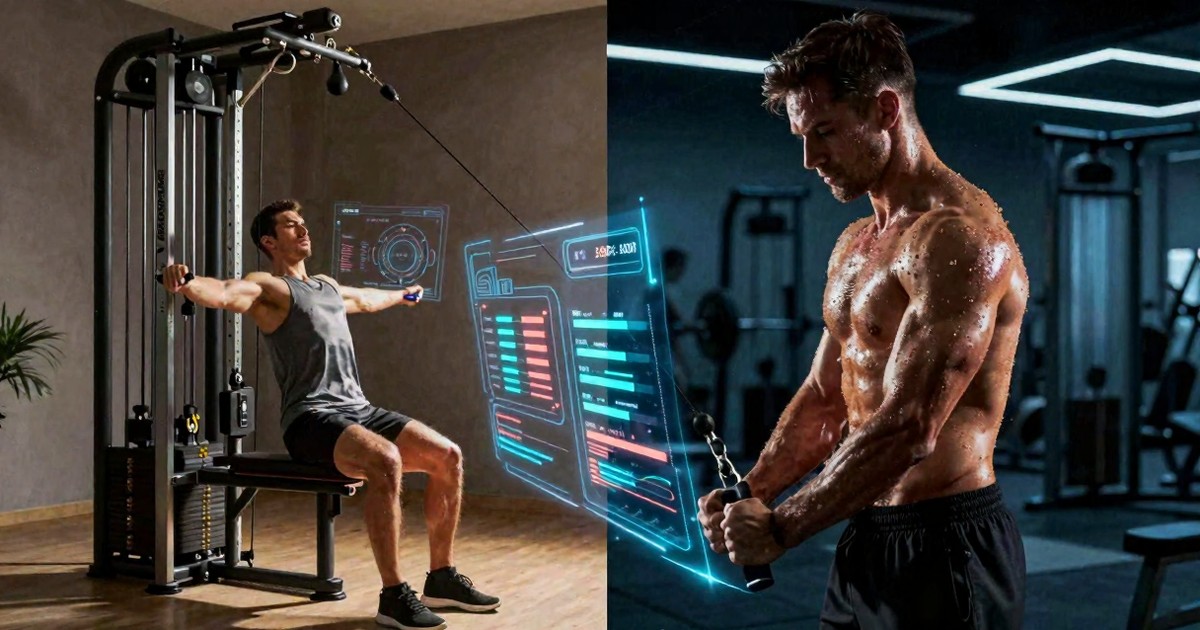
The K1's skeletal tracking camera sits at the bottom of the machine, facing up, hidden under a small magnetic privacy cover. That placement matters because it captures your full body without you doing anything to set it up. Speediance and Tonal rely on a separate phone camera (or, in Tonal's case, a built-in camera that isn't usable for live form tracking), which means you spend the first few minutes of every session propping, angling, and re-angling before you can lift.
Joel describes the K1's tracking as "almost instant." On Speediance and Tonal, the phone-camera approach produces feedback that feels slower and less consistent. The setup is fiddly enough that, in his words, the work of positioning the camera was often "more work than the net result of getting the form feedback." That's not a small complaint, because form coaching is the entire reason these cameras exist in the first place. If you have to fight the hardware to use the software, you eventually stop using the software.
Right now, the posture-based form feedback only works on a subset of workouts that AEKE has tuned for it (about 15 were rolling out at the time of the interview), with the plan to expand it across the full library. Joel hasn't done enough pure motion-tracking work yet to give a final score on the entire library, but the instant response on the camera-aware workouts is the differentiator that drove his purchase decision. It transforms the machine from a dumb cable stack into a responsive trainer.
AEKE K1 vs Speediance at a glance
| Feature | AEKE K1 | Speediance |
|---|---|---|
| Form-tracking camera | Built-in, base of unit, almost instant | Phone camera, setup required, slower |
| Display | 4K screen, readable from across the room | Smaller screen, harder to read at distance |
| Installation | Freestanding, wheels, no wall mount | Freestanding with frame accessory |
| Subscription | None, all features included | Core features moving behind paid membership |
| Custom workouts | Yes, build in app and upload | Yes, build in app and upload |
| Bluetooth connections | No practical limit (modern Android) | Capped at three (older Android build) |
| Software updates | Quarterly, four updates in six months | Less predictable cadence |
| Bonus content | Yoga, qigong, boxing, Pilates tracking | Strength-focused library |
| Customer support | ~48 hour email, custom PT mapping | Email can be slow; Facebook admins faster |
What the K1 gets right that competitors don't
No subscription, ever
AEKE's stated model is hardware-funded, not subscription-funded. Every feature Joel showed on screen, including the AI coach, custom workout builder, posture tracking, yoga, Pilates, qigong, boxing, and meditation, is included in the purchase price. Speediance has been moving more of its basic functionality behind a paid membership, which is a meaningful ownership-cost shift if you're budgeting over a three to five-year horizon. For many users, the "death by a thousand subscriptions" is a major deterrent; AEKE's "buy once, own forever" approach is a breath of fresh air in the tech space.
Quarterly updates with a public roadmap
Joel has owned the K1 for about six months and has already received roughly four software updates. AEKE publishes a roadmap and takes user votes on feature requests, which is a level of post-purchase engagement you rarely see in this category. You aren't just buying the software as it exists today; you are buying into a development cycle that is actively listening to the user base. This transparency helps mitigate the risk of buying into a newer brand.
A real mirror when you're not lifting
The K1 folds up into a clean mirror that "makes a beautiful mirror in the living room," per Joel. Speediance is also freestanding but doesn't have the same furniture-grade aesthetic—it looks like gym equipment. Tonal requires wall mounting, which rules it out for renters or anyone who doesn't want to commit to a permanent structural install. The K1's ability to disappear into the room's decor is a significant win for those with limited space or shared living areas.
4K screen, visible from across the room
Joel noted that he can read the K1's display from several feet away, which is a noticeable step up from the Speediance screen that often forces you to step close to see rep counts or instructions. For supersets, HIIT circuits, and quick glances mid-workout, that screen size and resolution matter more than the spec sheets suggest. It allows you to maintain your flow without constantly breaking form to check the monitor.
Support that actually solves problems
When Joel injured his rotator cuff, his physical therapist gave him a list of rehab exercises. He sent that list to AEKE support, and roughly two weeks later they returned a fully mapped custom workout he could run on the machine. That's the kind of response time and customization that turns a hardware purchase into a long-term relationship. While Speediance's email support has historically been slower—often requiring users to route through Facebook admins to get answers—AEKE's direct mapping service sets a new bar for customer care in fitness tech.
The honest gripes
No review is complete without the rough edges, and Joel was candid about where the K1 still needs work.
- Resistance ceiling: Joel's biggest wish for the next-generation K1 is heavier weight. He was hoping for parity with the 260 lb range, and the current resistance tops out lower than that. For advanced lifters, this might be a deal-breaker. While the community has responded with pulley and cable hacks that route external weight through the K1's frame, it's not an official solution.
- Wheels on tile: The K1 has two large wheels on the back that make it portable. On Joel's tile floor, the wheels catch on the grout lines, which makes moving it a bit of a chore. This is solvable with a gym mat, but worth knowing if your space has uneven flooring.
- Accidental button presses: The single engagement/disengagement button on the bar sits where your thumb naturally falls during certain grips. People with larger hands are most at risk of accidentally disengaging the weight mid-rep. Joel found that being deliberate about grip placement eliminates the issue, but it's a design quirk that could be improved.
- Schedule view: The weekly calendar on the device doesn't scroll to next week. You can only see the current week until that week arrives. It's a minor software annoyance, but it's frustrating if you like to plan your training blocks in advance.
- Streaming hiccups: On a slow internet connection, the camera-tracked yoga and qigong content takes a moment to buffer. Speediance pre-downloads its video at the start of a workout to avoid this, which is the trade-off the K1 makes for its always-on tracking and streaming architecture.
Who should buy the AEKE K1
Choose the K1 if you want a freestanding smart gym with no subscription, no wall mount, and a camera that gives you real-time form feedback without propping up a phone every session. It's also the right pick if you live somewhere without easy access to a personal trainer, because the AI coach and the mapping support together cover most of what a beginner-to-intermediate lifter needs. Joel's specific case—living in a rural area, an hour and a half from the nearest trainer, and recovering from injury—is exactly the user profile the K1 seems designed to serve.
Who should still consider Speediance
Speediance still makes sense if you already own one, prefer its specific app workflow, or want a specific accessory ecosystem that the K1 doesn't yet match. The frame-and-clip smart ring setup, for example, is something Joel admitted he had to buy separately for his Speediance and wishes the K1 offered natively with a fixed button. If you prioritize that specific physical handle interaction over integrated camera tracking, Speediance may still be your pick. Additionally, if you need the absolute highest weight ceiling available in a portable unit, Speediance currently has the edge.
Bottom line
The headline isn't clickbait. After six months of ownership, the camera is the feature Joel points to first. It is the feature Speediance and Tonal don't match because they didn't build the camera into the machine. Combine that with the lack of a monthly subscription fee, quarterly updates, a public roadmap you can vote on, and support that maps your physical therapist's exercises for you, and the K1 has earned its position as Joel's daily driver. For a deeper look at the on-device demo and the AI coach in action, watch the full conversation on YouTube.
Keep comparing
Make the next smart-gym decision with the full picture
Move from one review into model comparisons, real lifting data, and the matching video demonstrations.