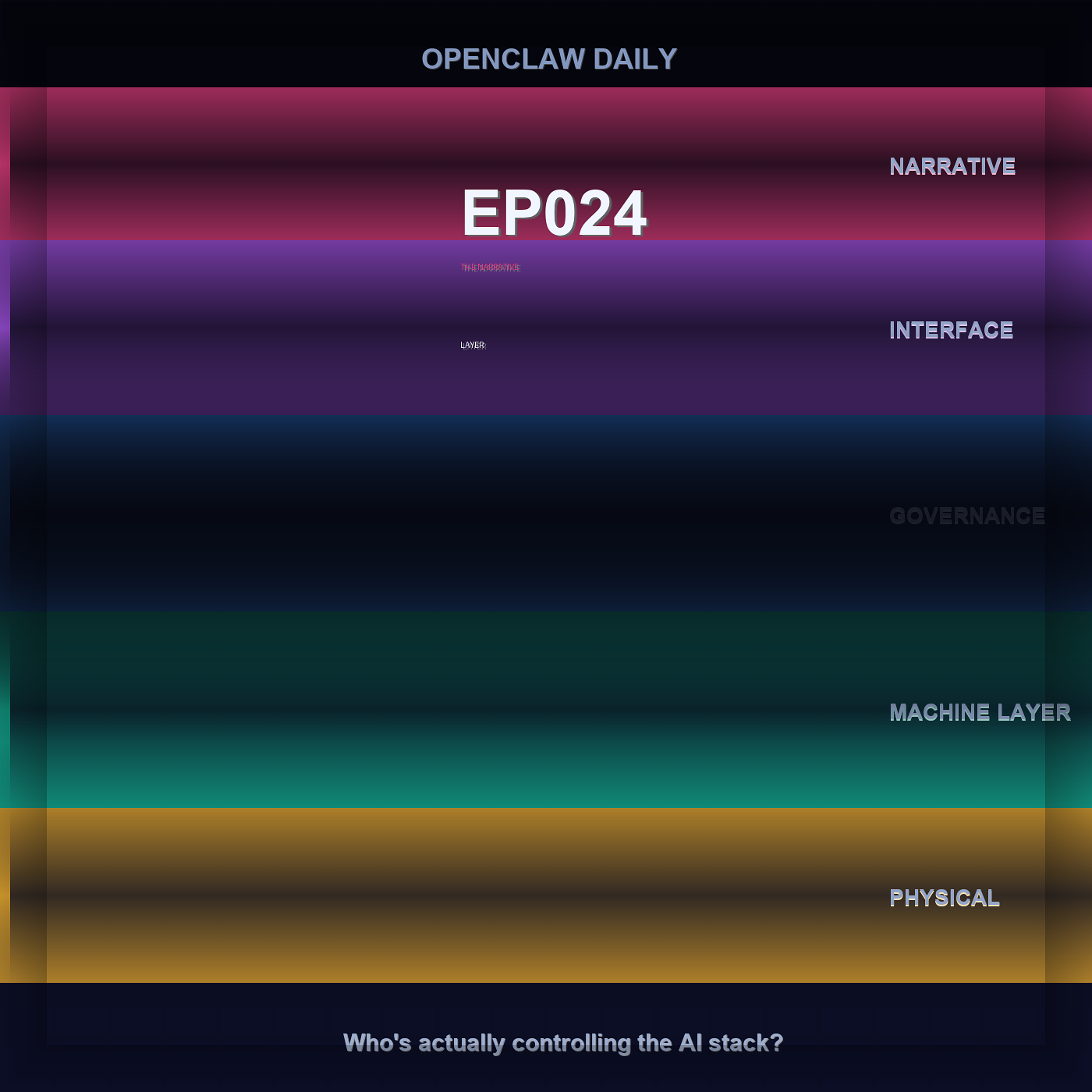
The Narrative Layer
OpenAI buys a media platform. Peter Steinberger highlights the CLI workaround culture forming around Anthropic's restrictions. Microsoft launches an open-source agent governance toolkit. Meta shows AI optimizing the machine layer underneath inference. Microsoft commits ten billion dollars to AI infrastructure in Japan on sovereignty terms. And in the United States, the data-center boom runs headfirst into an old-fashioned bottleneck: electricity. Six stories about who controls the AI stack — and whether the physical grid will let anyone finish building it. Show notes: https://tobyonfitnesstech.com/podcasts/episode-24/
🎧 Listen to EpisodeEP024 — The Narrative Layer
OpenClaw Daily | April 5, 2026 | ~35–40 min
Episode Title
The Narrative Layer
Tagline
AI companies are no longer just shipping models — they're buying media, locking the interface, governing agents, rewriting infrastructure, and deciding where the physical stack gets built.
Story Slate
1. OpenAI acquires TBPN
OpenAI bought TBPN, the fast-growing live tech talk show watched by Silicon Valley builders. NOVA and ALLOY dig into why this matters beyond media gossip: OpenAI is no longer just competing on models and apps, it's moving to shape the conversation around AI itself. The interesting tension is the promise of editorial independence versus the obvious incentive to own distribution and agenda-setting.
2. Peter Steinberger / Claude Code CLI workaround story
Peter Steinberger highlighted a workaround path using the Claude Code CLI route around Anthropic's restrictions on OpenClaw-style usage. This captures the ground truth of how technical communities react when a frontier lab tightens control: the operator class immediately looks for the seam. The hosts frame this as an interface-control story — not press releases, not legal frameworks, just the perennial pattern of vendors centralizing while users route around.
3. Microsoft launches the Agent Governance Toolkit
Microsoft released an open-source Agent Governance Toolkit focused on runtime security for autonomous agents: policy enforcement, identity, kill switches, execution rings, compliance mapping, and framework integrations. This reflects a maturity shift from "can agents do useful things?" to "how do you contain, observe, authorize, and stop them?" Enterprise AI is entering the governance phase.
4. Meta reveals KernelEvolve
Meta published KernelEvolve, an agentic system that writes and optimizes low-level kernels across heterogeneous hardware, with reported throughput gains for production inference workloads. This is deep-tech: AI being used to tune the machine layer beneath large-scale inference — not generating apps or copy, but optimizing the performance substrate itself.
5. Microsoft commits $10B to Japan AI infrastructure
Microsoft announced a $10 billion investment in Japan spanning in-country AI infrastructure, cybersecurity partnerships, and workforce training. The interesting angle is sovereignty: AI infrastructure is increasingly being sold on "your country's terms," with domestic data residency, local operators, and governance guarantees becoming part of the product.
6. US data center buildouts hit the power wall
Roughly half of planned US data center projects have been delayed or canceled because of shortages in power infrastructure and key components. Transformers, switchgear, grid capacity, and construction timelines are deciding what gets built — not model benchmarks or venture capital. The physical reality check that grounds the whole episode.
Show Notes block
# EP024 — The Narrative Layer
**OpenClaw Daily** | April 5, 2026 | ~35–40 min

Today's episode follows the power shift outward: who controls the conversation, the interface, the governance layer, the machine layer, the infrastructure map, and the physical buildout underneath AI.

## 1. OpenAI acquires TBPN
OpenAI has acquired TBPN, the live tech and business talk show that became a kind of insider daily brief for Silicon Valley. OpenAI says TBPN will keep editorial independence, but the larger signal is obvious: frontier labs are no longer content to ship products and hope the narrative sorts itself out. They want to own attention, framing, and daily mindshare.

## 2. Peter Steinberger / CLI workaround
Peter Steinberger highlighted a workaround path using the Claude Code CLI to route around Anthropic's restrictions on OpenClaw-style third-party agent usage. This is the interface-control story in its most practical form: when a platform owner says no, where are the remaining doors? The CLI remains the pressure-release valve for determined operators who need to get real work done.

## 3. Microsoft Agent Governance Toolkit
Microsoft released the Agent Governance Toolkit, an open-source runtime governance stack for autonomous agents. It includes policy interception, identity and trust layers, execution sandboxing, kill switches, compliance mapping, and integrations with common agent frameworks. Enterprise AI is maturing into infrastructure that must be governed like operating systems and distributed services.

## 4. Meta KernelEvolve
Meta published KernelEvolve, an agentic system that optimizes low-level kernels for GPUs, CPUs, and Meta's own MTIA chips. The company says it can compress weeks of expert optimization work into hours and produce major throughput gains on production workloads. AI is now being used not only at the application layer, but down in the performance engineering substrate itself.

## 5. Microsoft $10B Japan AI infrastructure
Microsoft announced a $10 billion investment in Japan from 2026 through 2029, combining in-country AI infrastructure expansion, cybersecurity collaboration, and large-scale workforce training. The shift is from generic cloud expansion to sovereignty-aware AI infrastructure: data residency, domestic operators, and national trust are now part of the sales pitch. AI infrastructure is becoming geopolitics with SLAs.

## 6. The US AI buildout hits the power wall
A fresh infrastructure report says nearly half of planned US data center builds have been delayed or canceled, largely due to shortages in electrical gear and supply-chain constraints. That reframes the AI race: not just who has the best model, but who can actually secure power, transformers, cooling, and construction timelines. The bottleneck is physical.

## Links
- OpenAI acquires TBPN: https://openai.com/index/openai-acquires-tbpn/
- Guardian coverage on TBPN deal: https://www.theguardian.com/technology/2026/apr/02/openai-talk-show-tbpn
- Peter Steinberger CLI workaround: https://steipete.me/
- Microsoft Agent Governance Toolkit: https://opensource.microsoft.com/blog/2026/04/02/introducing-the-agent-governance-toolkit-open-source-runtime-security-for-ai-agents/
- Agent Governance Toolkit repo: https://github.com/microsoft/agent-governance-toolkit
- Meta KernelEvolve: https://engineering.fb.com/2026/04/02/developer-tools/kernelevolve-how-metas-ranking-engineer-agent-optimizes-ai-infrastructure/
- Microsoft $10B Japan investment: https://news.microsoft.com/source/asia/2026/04/03/microsoft-deepens-its-commitment-to-japan-with-10-billion-investment-in-ai-infrastructure-cybersecurity-workforce/
- US data center delays / power bottlenecks: https://www.tomshardware.com/tech-industry/artificial-intelligence/half-of-planned-us-data-center-builds-have-been-delayed-or-canceled-growth-limited-by-shortages-of-power-infrastructure-and-parts-from-china-the-ai-build-out-flips-the-breakers