Whoop vs Garmin for Jiu-Jitsu: The Honest Wearable Trade-Off
Choosing between Whoop and Garmin gets tricky when your training includes grappling, lifting, running, and sleep tracking. This review breaks down the real-world trade-offs that matter after the honeymoon period.
I have been wearing fitness trackers for a long time. Before the current wave of recovery scores, strain numbers, body batteries, sleep stages, and readiness metrics, I had a Microsoft Band. Then I had the early Apple Watch. Then I moved through random Android wearables, Garmin watches, and eventually Whoop.
So when I compare Whoop and Garmin for jiu-jitsu, strength training, running, and daily health tracking, I am not looking at them like a spec-sheet reviewer. I am looking at them as someone who actually wears the devices, trains with them, sleeps with them, breaks routines with them, and notices which annoyances matter after the honeymoon period is over.
The short version is this: Whoop still has the best form factor for jiu-jitsu, but Garmin is the better long-term fitness technology platform for almost everything else.
The Apple Watch Problem
I know a lot of people love the Apple Watch. I did not. My experience was with the early generations, so maybe the newer versions have fixed many of the problems, but the first and second generation Apple Watches left a bad taste.
They crashed. They nagged. They wanted attention. They constantly felt like a small phone strapped to my wrist, which is exactly what I do not want during training or throughout the day.
The notification problem is a big one for me. I do not want my wrist buzzing all day. I do not want a device trying to pull me into messages, reminders, stand prompts, rings, alerts, or random bits of digital noise. Yes, you can turn notifications off. But my experience was that updates had a habit of reintroducing settings, resetting preferences, or making the whole thing feel like nagware again.
For fitness tech, I want a tool. I do not want another attention machine.
Why I Ended Up Back With Garmin
Garmin has a major advantage that does not always show up in short-term reviews: the devices last forever.
I still have older Garmin watches that work. My original Fenix still works. I could put it on tomorrow and go run with it. I probably will not, because it is heavy and old, but the point is that it still functions.
That matters. A lot of modern wearables feel disposable. Garmin watches feel like durable training tools. They may eventually become outdated, and you may want newer features, but they do not become useless overnight.
Right now I use a Garmin Forerunner 265S. That might seem like an odd choice if you assume bigger is always better, but I picked it very intentionally. I wanted something light enough to sleep with, because Garmin’s daily suggested workouts require sleep data to be useful. If I am going to wear a device overnight, comfort matters more than having every possible high-end feature.
I previously had larger Garmin watches, including a Fenix and a higher-end Forerunner. They were capable, but they were heavier. For my current use case, the 265S hits the sweet spot: light, capable, relatively affordable by Garmin standards, and full of the features I actually use.
The Garmin Feature Advantage
Garmin’s product lineup can be confusing. The naming structure is brutal. Forerunner, Fenix, Epix, Instinct, Venu, different generations, different sizes, different suffixes — it is a lot.
But that confusing lineup also reflects one of Garmin’s strengths: choice.
With Whoop, you basically choose between the standard Whoop 5 and the MG version. They are similar devices, with the MG adding extra sensors. With Garmin, you can choose a watch based on running, hiking, battery life, maps, weight, size, price, screen, durability, and training features.
For me, maps are not a major factor. If I am hiking, I am going to load maps on my phone. I am not trying to be device-free in the wilderness. So I do not need the biggest Garmin with every navigation feature. I need something that tracks runs, supports daily workouts, gives me useful recovery data, and is comfortable enough to wear consistently.
That is where the Forerunner 265S makes sense.
The Whoop 5 Size Claim Is Misleading
Now let’s talk about Whoop, because there is one thing that really bothers me about the Whoop 5 conversation: the claim that it is smaller.
Technically, Whoop can say the device is smaller in certain dimensions. It is narrower. It may be shorter in ways that show up on a measurement chart. But the dimension that actually matters on your wrist is height.
How far does the device sit off your wrist?
That is what affects comfort, snagging, and how noticeable the device feels. And in that meaningful dimension, the Whoop 5 is not smaller in the way people imply. It is thicker. It has better battery life, which is great, but that battery improvement came with a physical trade-off.
When people repeat the company narrative that the Whoop 5 is smaller, they are missing the practical point. It may be smaller in dimensions that matter less, while being larger in the dimension that matters most.
That is especially frustrating because the new shape also means older bands and accessories do not work properly. As a customer, that feels intentional, even if the engineering trade-off was more complicated than that. I have had to hack around accessory fit with spacers, which is ridiculous for a premium subscription-based wearable.
Whoop Still Wins for Jiu-Jitsu
Here is the part where Whoop still has a real advantage: grappling.
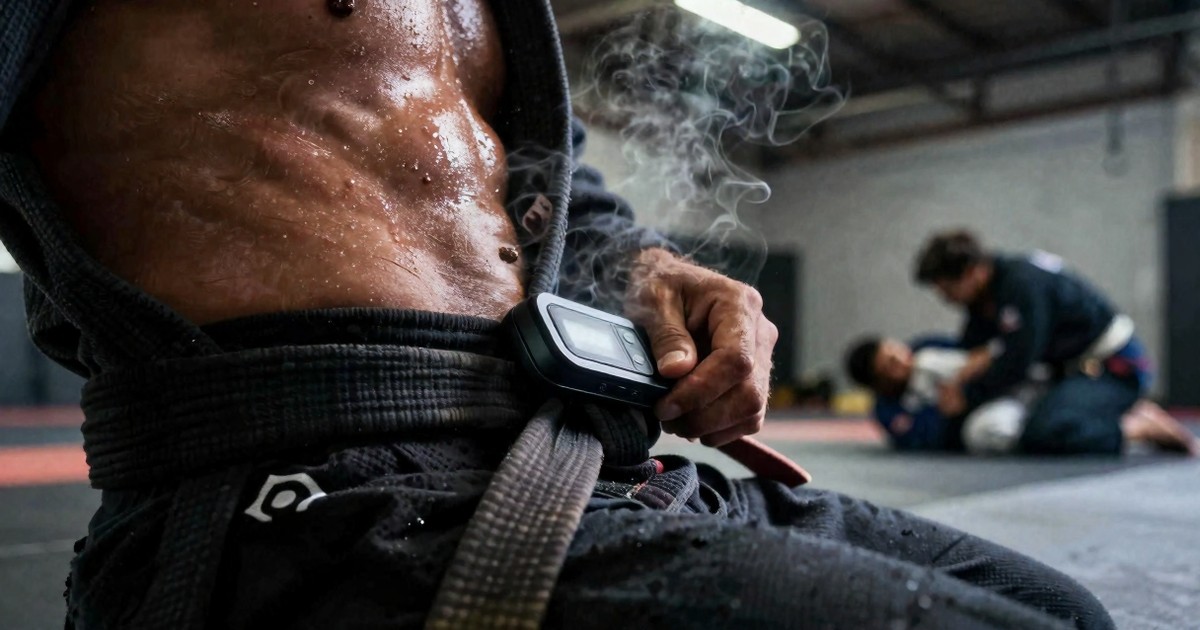
Wrist-based watches are bad for jiu-jitsu. You cannot realistically wear a Garmin watch during sparring. It is uncomfortable, unsafe, and likely to get in the way. Chest straps are also bad for jiu-jitsu. I have tried them. They suck. They shift, they dig in, and they are not something I want under pressure in live rounds.
Whoop’s advantage is that it can be worn somewhere else, especially on the bicep or in compatible apparel. That makes it much more practical for jiu-jitsu than a traditional watch.
This is the one area where Garmin needs a better answer. If Garmin wants to truly compete with Whoop for combat sports, it needs a sensor that can be comfortably worn on the bicep or somewhere similarly protected. A chest strap is not enough. A watch is not enough. Grappling requires a different form factor.
Recovery Scores: Garmin Is Catching Up
Garmin has been adding more health and recovery-style tracking over time. Body Battery, sleep tracking, training readiness, HRV status, and other health metrics are moving Garmin closer to the territory Whoop helped popularize.
In my case, some of Garmin’s newer health tracking features were still calibrating when I checked them. That makes it hard to give a final verdict on how close Garmin is to Whoop in this specific recovery dashboard sense.
But Garmin already has one huge advantage: it does not require the same subscription model to remain useful. The data, workouts, running features, device longevity, and training tools are all part of the watch experience.
Whoop’s value proposition depends heavily on whether you love its recovery ecosystem and whether its form factor solves a specific problem for your sport.
Who Should Choose Garmin?
Garmin is the better choice if you:
- Run regularly and want strong workout guidance.
- Care about device longevity.
- Want a screen during workouts.
- Prefer owning a durable training watch over paying forever for a subscription wearable.
- Do not need to wear the device during grappling rounds.
- Want fewer distractions than an Apple Watch.
For most people who train strength, run, hike, cycle, or just want a dependable fitness watch, Garmin is very hard to beat.
Who Should Choose Whoop?
Whoop makes more sense if you:
- Train jiu-jitsu, wrestling, MMA, or another sport where watches are not practical.
- Want a screen-free wearable.
- Care deeply about recovery scores and habit tracking.
- Are willing to pay for the subscription.
- Need bicep or apparel-based wearing options.
For jiu-jitsu specifically, Whoop still solves a problem Garmin has not solved elegantly yet.
The Bottom Line
If I had to pick one ecosystem for long-term training, I would lean Garmin. The watches last, the feature set is deep, and the platform is useful without constantly demanding attention. Garmin feels like training equipment.
But if the question is specifically, “What can I wear during jiu-jitsu?” then Whoop still has the edge because of the form factor. Not because the device is perfect. Not because the Whoop 5 size claims are as meaningful as they sound. Not because the accessory changes are customer-friendly. But because being able to move the sensor off the wrist matters.
That is the honest trade-off. Garmin is the better overall fitness tech platform. Whoop is the more practical grappling wearable. If Garmin ever releases a proper bicep-worn sensor that integrates cleanly with its ecosystem, that comparison could change fast.
Use the data
Compare the wearable, then see what the numbers look like
Continue into hands-on comparisons, live WHOOP recovery data, and the broader tracker guide.
Keep Reading
Related Posts
Are Fitness Trackers Actually Accurate? Garmin Body Battery vs Whoop
Why Official APIs Are Not Enough for Your Fitness Data Ecosystem