1.2 Million Pounds: What 7 Months on the Speediance Actually Taught Me
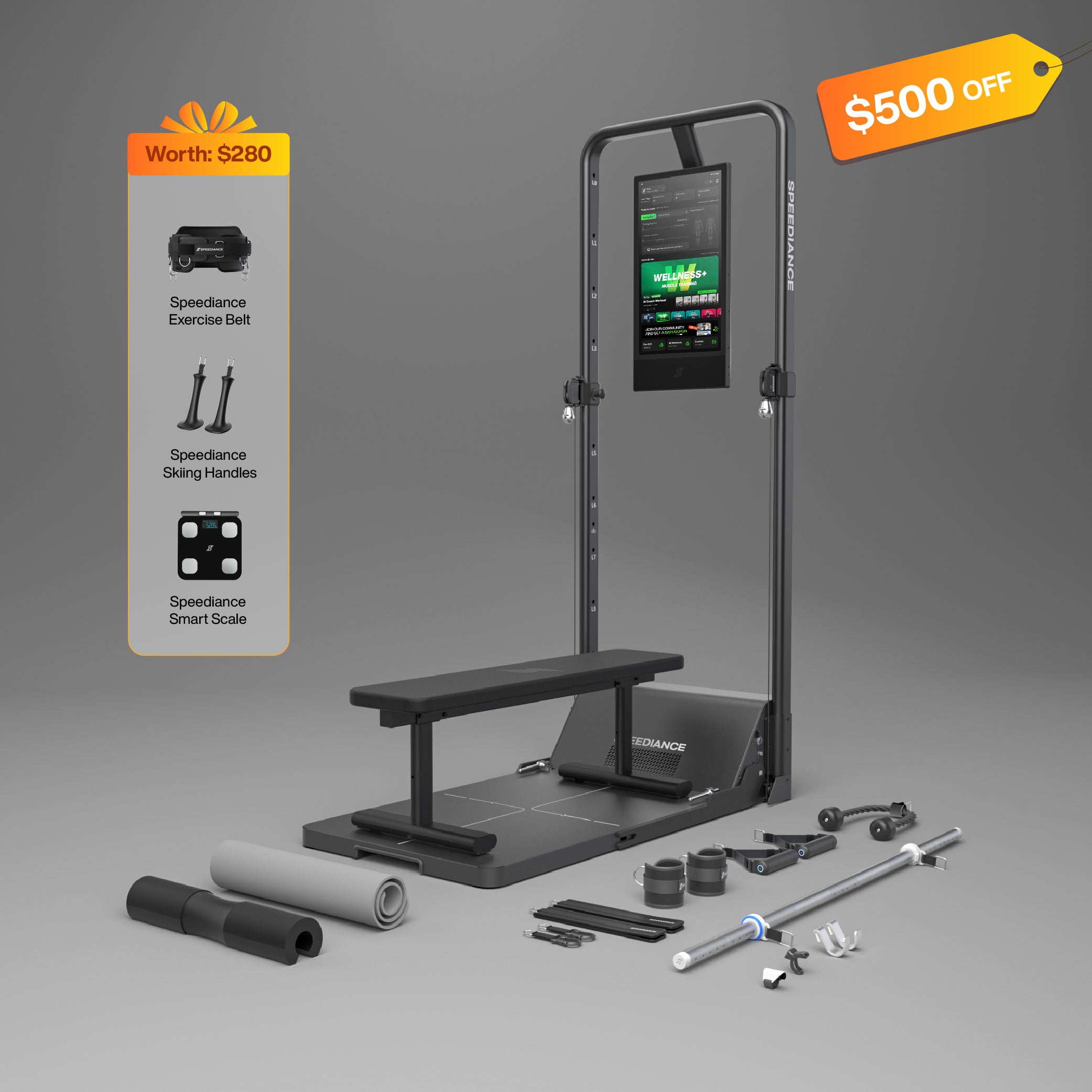
I've logged 125 workouts and 1,296,447 lbs of total volume on the Speediance Gym Monster 2S since July 2025. Here's what the data actually revealed — the patterns I didn't expect, the software that nearly broke me, and why I still have two of these machines in my house.
The Number Nobody Told Me About
1,296,447 lbs. That's the total volume I've logged on the Speediance Gym Monster 2S since July 25, 2025. One hundred twenty-five workouts across roughly seven months. I know the exact number because the machine tracks it — and because I also pull it through my own AI-built fitness dashboard every morning, cross-checking it against WHOOP strain and Garmin data so nothing gets lost in a walled garden.
When I hit a million pounds lifted on the device back in late January, I'd already made a video about it. But 1.2 million has a different weight to it — no pun intended. It's the number where I can actually tell you what's real, what the marketing doesn't cover, and what seven months of serious daily use actually reveals about a piece of fitness technology.
So let's get into it.
What the Volume Data Actually Shows
My best single session was February 2, 2026: 35,305 lbs in 50 minutes. That's a number that sounds absurd if you've never trained on a digital resistance machine, but it's real — it's what happens when you're doing 13 reps per set across 15+ exercises with weights in the 80–200 lb range, plus warm-up sets. The machine doesn't let you skip accounting for any of it.
My top workout program is Warrior 1, which I've run 27 times at an average of 18,302 lbs per session. That's the backbone of my upper-body pulling work. Behind that, I rotate through dedicated Back Barbell and Chest Handles programs that I built myself using the custom workout builder — not the stock programs. The stock programs are fine if you want guided, but they don't match the way I lift, which is one warm-up set at 20 RM for 13 reps, then one working set at 15 RM for 13 reps (with Unlimited Sets turned on so the machine keeps going if I'm pushing beyond the target).
My exercise PRs from this run:
- Barbell lat pulldown: 294 lbs 1RM (estimated from working weight × rep formula)
- Seated barbell wide row: 202 lbs 1RM
- Bench press: 90 lbs via Speediance cable resistance
The weight gain is real too. I started the Speediance program when my body weight was sitting around 203–205 lbs. As of early 2026, I'm at 218.4 lbs per the Garmin scale — and I know from the body composition that this isn't fat gain. The transformation from 242 to 188 lbs happened in 2023 and that story is its own post. What the Speediance has done is put me in the strength-build chapter, not the weight-loss chapter.
The Software: Honest Assessment
I have to be straight with you about this because I've watched too many reviewers gloss over it.
The V2.x software was solid. Not perfect, but solid. The V3.0 rollout was a mess — they removed partner mode from Freelift, shipped a broken UI, and added a Safety Start button to my screen that literally did nothing because the firmware for my unit wasn't ready. I sat with a non-functional feature button for weeks.
V3.1 came with the new firmware. The Safety Start now works — and I've dedicated an entire separate post to why I think it's the wrong solution to the right problem. The short version: it limits your range of motion in exchange for preventing cable retraction into the machine, and the retraction after the firmware update is noticeably slower in ways that concerned me.
What they did right in V3.1: they finally prompt you when the machine wants to increase your working weight during bilateral movements. For a long time, it would just silently apply a new heavier weight and you'd hit the cables unprepared. That was the real safety issue — not whether the cables retract fast enough. V3.1 appears to have fixed it for barbell and dual-handle movements, though I've still caught it misfiring on unilateral exercises.
The progressive overload logic has also had some strange phases. There was a version where it was overloading users too aggressively (I saw it firsthand — it set me up for an overhead tricep extension at nearly my overhead press max). Then they overcorrected and it stopped auto-overloading entirely. Right now, you have to manually trigger progression by lifting above the prescribed weight. I actually don't mind this approach — I prefer to own the decision — but new users expecting the machine to just handle it will be confused.
The Processor Upgrade Nobody Talks About
I reached out to the Speediance team directly and asked for the specific processor specs in each machine generation. They confirmed: the 2S and 2 have a meaningfully upgraded processor from the original. They don't publish this anywhere. You won't find it on the spec sheet.
The practical difference is subtle but real. The scrolling on the 2S is noticeably smoother. The loading screen that appears when you hit Start is half a second shorter. Neither of these impacts a workout — but it explains why some features like Safety Start and the upcoming Pilates integration are only coming to the newer hardware. It's not marketing speak. There are actual compute requirements at play.
I have the original Speediance downstairs and the 2S up in my office. The original is still a great machine — I do my arms-focused workouts on it all the time because those weights never exceed what it's capable of. If you can find an open-box original at Walmart (I've seen them go for $1,000–$1,500 with full warranty), that's an absurd deal.
What the Data Actually Changed
Here's the thing I didn't expect from tracking 1.2 million pounds: it changed how I make decisions about training. When I can see that my last three sessions averaged 22,000 lbs and I've had 3.5 hours of sleep (more on that in the WHOOP post), I know that today's session ceiling is probably 12,000 lbs and I should adjust before I start — not halfway through when I'm gassed.
The challenges Speediance runs on the platform have also meaningfully changed my programming. The Lunar Flow challenge forced me to rethink high-volume sessions. Before it, my typical session was a full upper-body day at 30,000–40,000 lbs that required a recovery day after. The challenge pushed me to develop smaller, targeted daily sessions. I found I actually like both formats now and alternate between them.
One real frustration: the partner mode situation. My wife works out on the machine downstairs and I'm upstairs. We cannot do a custom workout together. We cannot count her lifts against her profile if we work out side by side. This has been the number-one community request for two years. Tonal had it from day one. I understand V3.0 broke what little partner mode existed, V3.1 partially brought it back, but the right version — logged-in profiles, custom workouts, dual-load that actually tracks both people — doesn't exist yet.
That's the thing about the Speediance. It's genuinely great. It's also still maturing, and if you expect it to just work perfectly the way consumer products are supposed to, you'll be disappointed at least occasionally. If you treat it like what it actually is — sophisticated training hardware with active firmware development and a responsive team — you'll be fine.
After 1,296,447 lbs, I'm still on it every day I can be. That's the real verdict.
Keep Reading
Related Posts
How I Built My AI Fitness Assistant with OpenClaw

The V3.1 Change That Finally Makes Progressive Overload Work